
Find ISL Products Online at 


Design Note
Brushless vs. Brushed Motors
A Comprehensive Guide to Performance, Efficiency, and Cost Differences for Industrial and Consumer Applications
Key Differences and Applications for Brushed and Brushless DC Motors
When selecting a DC motor for your application, one of the most crucial decisions is choosing between a brushed or brushless motor. Both technologies convert electrical energy into mechanical energy, but their distinct constructions dictate their efficiency, lifespan, and ideal use cases. This guide explores the brushless vs. brushed motor debate to help you make an informed component selection.
Understanding the Core Differences in Construction and Operation
The fundamental difference between these two motor types lies in how the electrical current is commutated to create a rotating magnetic field.
The Working Principle of Brushed DC Motors
A brushed motor features a simple design consisting of a permanent magnet, a rotor, a stator, brushes, and a commutator. When an electric current flows through the rotor’s armature windings, it generates a magnetic field that interacts with the stator’s permanent magnets to cause rotation.
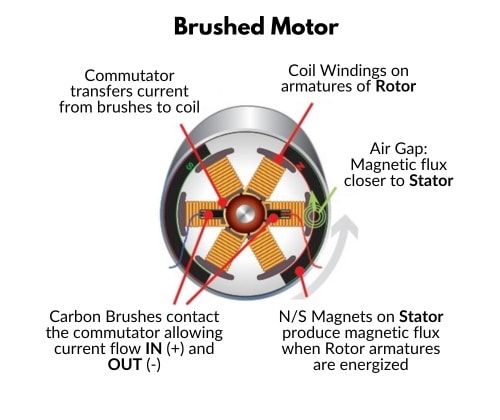
The rotating commutator acts as an electrical switch, reversing the current direction every half turn to ensure continuous rotation. Typically made of carbon or precious metals, the brushes maintain constant physical contact with the commutator. While this allows for easy control of speed and torque by varying the current polarity, the physical contact creates friction, leading to mechanical wear and sparking.
The Working Principle of Brushless DC Motors (BLDC)
A BLDC motor eliminates physical brushes and commutators entirely. Instead of physical contact, brushless motors utilize electronic controllers to orchestrate electronic commutation.
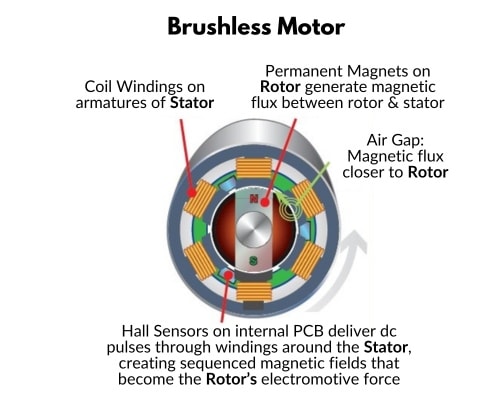
In a brushless motor, the permanent magnets are mounted on the rotor, and the electrified coils are located on the stator. Hall sensors are commonly used to detect the exact position of the rotor; this data is sent to the electronic controller, which precisely times the current flowing through the stator coils to pull the rotor along. Because there is no physical contact to transfer power, BLDC motors experience significantly less friction.
Comparing Performance: Advantages and Disadvantages
Service Life and Maintenance
Brushed motors are prone to mechanical wear because the physical brushes gradually erode during operation. This limits their overall lifespan and may require brush replacement. Conversely, brushless motors boast a significantly longer service life because they lack these degrading physical contacts.
Speed, Acceleration, and Efficiency
Operating with electronic commutation, brushless motors experience minimal friction and exhibit higher overall efficiency. They convert a larger percentage of electrical energy into mechanical energy, resulting in faster speeds, better acceleration, and a wider speed range. Brushed motors, hindered by physical brushes, operate at slower speeds and carry a higher risk of sparking if pushed to high RPMs.
Electrical and Acoustic Noise Generation
If your application involves sensitive circuitry, electrical noise (EMI) is a major consideration.
- Brushed Motors: The arcing and sparking that occur as brushes make and break connections with the commutator generate significant electrical noise, which can interfere with nearby electronic components. Adding capacitors to the motor terminals can help mitigate this EMI.
- Brushless Motors: Because digital controllers deliver electricity smoothly without physical arcing, BLDC motors produce vastly less electrical noise.
Acoustically, brushed motors can be noisy due to brush friction. While brushless motors lack this internal friction, their high-speed capabilities can sometimes generate audible noise due to air resistance, resonance, or “coil whine” from the high-current electronic components.
Choosing the Right DC Motor for Your Application
Selecting the right motor requires balancing your budget, performance needs, and physical constraints.
Cost Considerations
Brushed DC motors are generally more affordable due to their simpler manufacturing process and lack of complex electronics. Brushless motors carry a higher initial cost because they require external or integrated electronic drivers. However, if your application requires continuous, long-term operation, the extended motor lifespan of a BLDC motor often yields greater cost savings over time.
Gearbox Requirements and Torque
If your application demands high torque at lower speeds, you will need to couple your motor with a gearbox. Because brushed motors naturally operate at lower speeds, they are less likely to cause issues with internal gear engagement. When pairing a high-speed BLDC motor with a gearbox (such as a spur or planetary gearbox), the input speed must be carefully considered to avoid damaging the gears.
Control and Precision
Since brushless motors require electronic controllers, they naturally offer highly precise and variable speed adjustments. However, brushed DC motors can also achieve excellent precision when paired with proper electronics, such as utilizing Pulse Width Modulation (PWM) for speed control, or by adding optical encoders to create highly accurate Servo motors.
Source Custom DC Motors with ISL Products
Whether your application demands the cost-effective simplicity of a brushed motor or the high-speed efficiency of a brushless design, optimal performance comes down to exact specifications.
With over four decades of experience, ISL Products specializes in customizing our motors to fit your specific size, voltage, and performance needs. Request a Quote or use our Motor Selection Guide today to collaborate directly with our engineers and find the perfect motor for your application.
