
Find ISL Products Online at 


Design Note
Planetary Gear Motors vs. Spur Gear Motors
Compare planetary and spur gear motor technologies to optimize efficiency, torque density, and acoustic performance for your specific electromechanical application
Comparing Planetary and Spur Gear Motors for Engineering Success
In the world of industrial applications and precise electromechanical motion control, selecting the right DC gear motor is one of the most critical decisions an engineering team will make. While the electric motor itself generates the raw speed and power, it is the attached gearbox that dictates how that power is practically applied.
The two most common and effective speed-reducing technologies on the market are planetary gear motors and spur gear motors. Both gear head configurations possess their own unique mechanical advantages, physical footprints, and operational limitations based on their intended usage. Understanding the fundamental differences in their construction is essential for optimizing your application’s efficiency, acoustic noise, and overall lifespan.
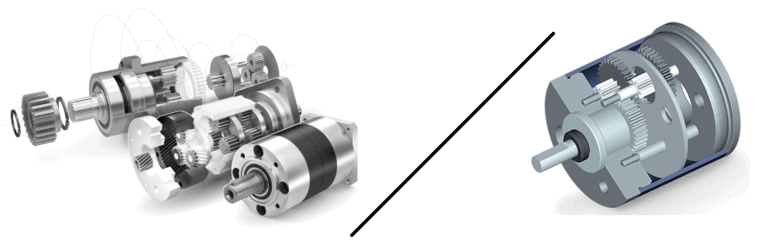
Understanding Spur Gear Motors
A spur gear motor is the most traditional and widely recognized type of gear reduction system. It offers a highly reliable, cost-effective solution for a massive variety of general-purpose applications.
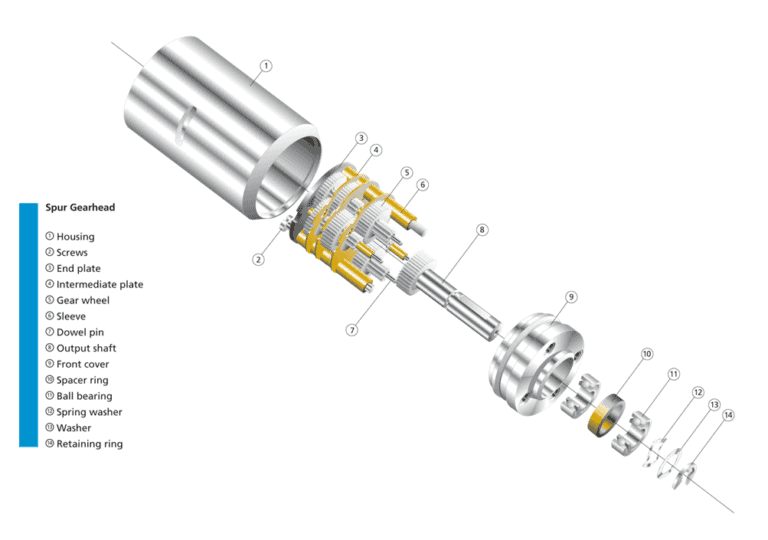
Construction and Mechanics
A spur gear head’s internal construction consists of a series of straight-cut gears mounted on parallel shafts. These shafts are offset from one another. The motor’s pinion gear drives a larger gear on the first parallel shaft, which in turn drives the next gear in the sequence. The continuous meshing of the smaller gears with the larger gears systematically reduces the motor’s RPM, transforming that high-speed rotational energy into usable mechanical torque.
The most critical characteristic of a spur gearbox is that it utilizes a single point of contact at any given time. This means that the entire mechanical load—and all of the physical stress—is held completely by a single tooth meshing between two gears.
Advantages and Ideal Applications
Because of their relatively simple internal construction, spur gear motors are highly cost-effective to manufacture and incredibly easy to integrate. They are best suited for low-torque and low-RPM applications.
If a spur gear motor is driven at excessively high speeds, the single-contact gear teeth will produce a significant amount of acoustic noise and vibration. Furthermore, at high speeds, internal lubrication tends to disperse and fling outward away from the gear teeth, increasing friction and wear. Therefore, they excel in steady, moderate applications such as automated paper towel dispensers, telescope positioning equipment, electromechanical door locks, and small motorized appliances.
Understanding Planetary Gear Motors
When an application demands maximum power density, extreme durability, and high precision within a compact footprint, engineers turn to the planetary gear motor (also known as epicyclic gearing).
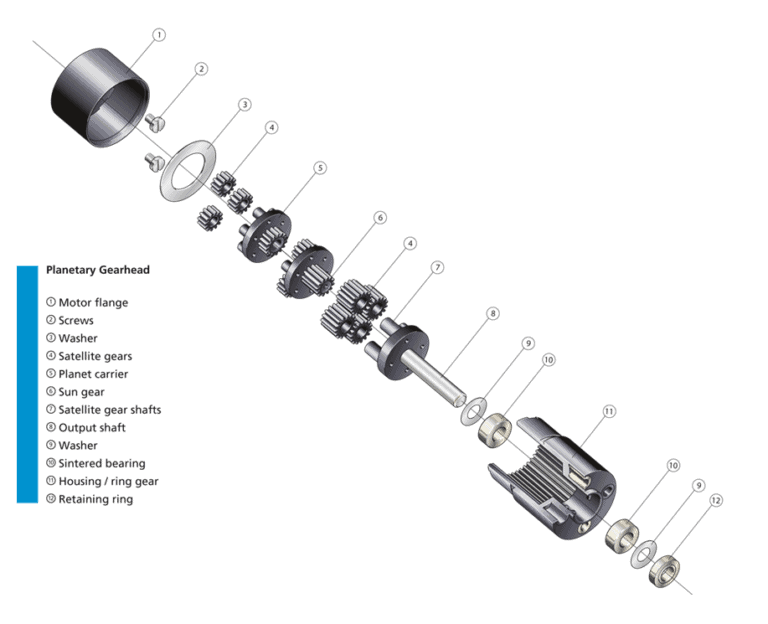
Construction and Mechanics
The gears inside a planetary gear head utilize a highly complex and unique method of meshing together. The system consists of three primary components:
- The Sun Gear: An internal central gear that is driven directly by the motor shaft.
- The Planetary (Satellite) Gears: Multiple gears (usually three or four) that continuously revolve around the central sun gear.
- The Ring Gear: A fixed, stationary outer ring with inward-facing teeth that houses and guides the planetary gears.
As the central sun gear rotates, it drives the multiple planetary gears simultaneously. Because the sun gear meshes with multiple outer gears at once, the mechanical load is distributed evenly across multiple contact points.
Advantages and Ideal Applications
The ability to distribute a heavy mechanical load over multiple gear teeth simultaneously makes planetary gear motors optimal for high-torque, high-RPM applications. They can sustain massive operational shock loads that would easily shear the teeth off a standard spur gear.
Additionally, in planetary systems, the centrifugal force of the rotating gears naturally traps the internal gear lubrication within the teeth, ensuring smooth operation and a long operational lifespan even at high continuous speeds. Due to their incredible precision and power density, planetary gear motors are the industry standard for robotic assemblies, industrial label printing machines, tactical defense robotics, vinyl cutting machines, and automated laser measuring apparatuses.
Key Design Comparisons
When deciding which gear motor is best suited for your device, keep the following physical and operational comparisons in mind:
- Torque and Speed Limits: A planetary gear motor is vastly more effective in high-speed, high-torque environments due to its load distribution. A spur gear motor is better suited for lower speeds and loads highly efficient, but its single-tooth contact point limits its maximum load capacity before mechanical failure occurs.
- Physical Footprint and Size Constraints: Due to their inline epicyclic construction, planetary gear motors are typically much narrower and longer, making them ideal for cylindrical spaces. Conversely, because spur gears require parallel, offset shafts, the resulting gearbox is often wider and non-symmetrical, which requires a different spatial footprint inside your device chassis.
- Efficiency and Cost: While planetary gearboxes offer higher mechanical efficiency and greater durability, their complex construction makes them more expensive to manufacture. If your application does not require massive torque or high RPMs, a properly geared spur motor will provide excellent efficiency at a much lower price point.
Optimize Your Gear Motor Selection
Choosing the proper gear motor configuration depends entirely on your project’s unique specifications, spatial constraints, and target budget. This decision can often be time-consuming and heavily reliant on trial and error if approached blindly.
Gearhead Comparison
Pros
Cons
Spur
Gear Motor
Gear Motor
- Cost Effective
- Easily Maintained
- Simple Design
- High Gear Ratio
- High Torque Density
- Noisy at High Speeds
- Prone to Wear
- Lower Load Capacity
Planetary
Gear Motor
Gear Motor
- High Load Capacity
- Efficient Power Transmission
- Great Stability
- High Power Density
- Higher Price
- Longer in Length
ISL Products has an extensive history of designing and manufacturing both brushed and brushless DC motors paired with highly customized planetary and spur gear heads. Our applications engineers are ready to tailor a gear motor specifically to meet your exact speed, torque, and dimensional requirements.
