
Find ISL Products Online at 


Design Note
Piezo Buzzers vs. Magnetic Buzzers
Optimize your audible alert design by comparing the electrical characteristics, physical constraints, and Sound Pressure Level (SPL)
Choosing Between Piezo and Magnetic Buzzers for Your Device
When designing an electronic device that requires an audible alert, alarm, or user-feedback tone, engineers face a critical choice in the audio component selection process. While there are many variations on the market, the decision usually comes down to two primary technologies:
Both technologies serve as excellent solutions for producing sound, but they possess entirely unique electrical characteristics, physical construction, and acoustic outputs. Choosing the correct buzzer type relies heavily on your application’s specific size constraints, available power, and desired Sound Pressure Level (SPL).
Understanding the Method of Operation
To make the right choice, it is essential to understand the physics driving each component.
How Piezo Buzzers Work
Piezoelectric sound elements utilize a highly unique convention based on the piezoelectric effect. There is no magnetic field and absolutely no copper voice coil used in their construction.
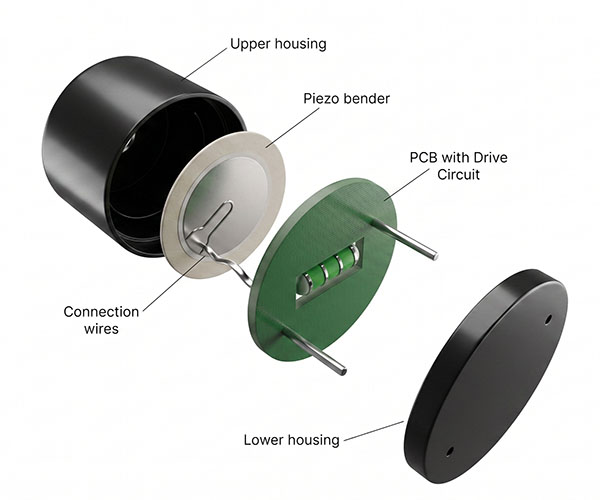
Instead, a specialized ceramic material is bonded to a metal diaphragm. Applying an electric field to this piezoelectric material causes it to physically change size—expanding and retracting as electrical charges are introduced and removed. This rapid oscillation of the diaphragm produces the audible sound wave. Because they lack bulky internal magnets, piezo buzzers feature a unique slim-line profile, making them highly attractive for modern electronics with severe physical size constraints.
How Magnetic Buzzers Work
Magnetic buzzers are much more traditional in their make-up. They operate on the electromagnetic effect.
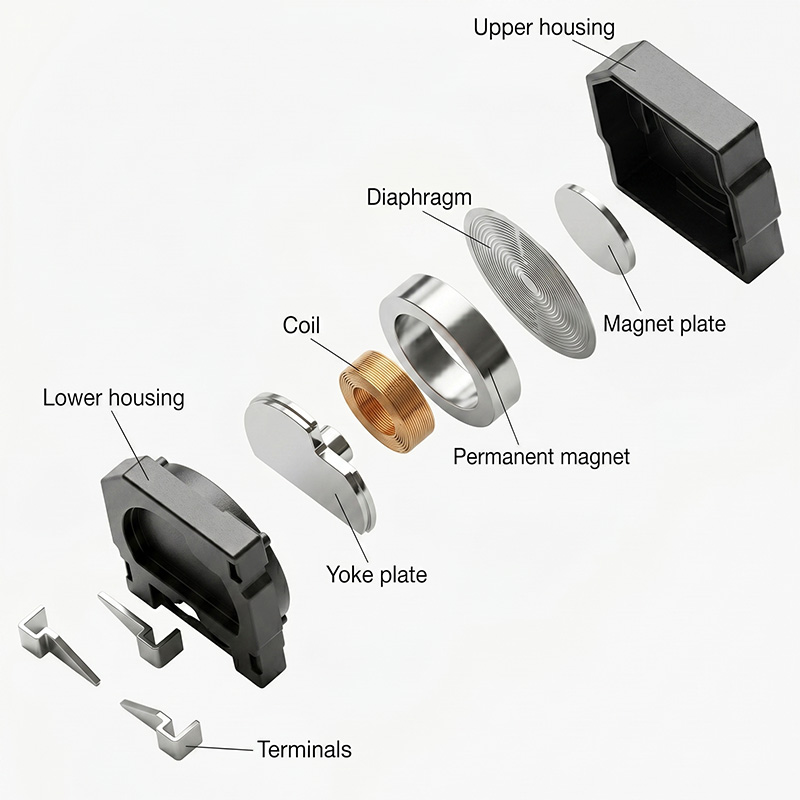
An electrical current is driven through a tightly wound voice coil to produce a magnetic field. When an alternating voltage is applied, the coil generates a fluctuating magnetic field that interacts with a permanent magnet, causing an attached metal diaphragm to vibrate and produce sound. Because of this mechanical architecture, they tend to be physically larger and heavier than their piezo counterparts.
Key Technical Comparisons
Aside from physical size, the electrical parameters—such as operating voltage, current draw, and resonant frequency—are the defining factors when choosing between a piezo and magnetic buzzer.
1. Operating Voltage and Current Consumption
- Piezo Buzzers: Known for their extreme efficiency, piezo buzzers draw incredibly low current—typically <10 mA. However, they require a much wider and often higher operating voltage range to function, generally spanning from 3V to 250V.
- Magnetic Buzzers: These are ideal for low-voltage systems. Their typical operating voltage ranges from just 1.5V to 12V. The trade-off is efficiency; driving the magnetic voice coil requires higher current, commonly 20mA to over 60mA.
2. Resonant Frequency
Every audio component has a specific frequency at which it vibrates most efficiently; this parameter is called the resonant frequency. Driving a buzzer with an input signal that matches its resonant frequency will create the greatest SPL with the least amount of input power.
- Piezo Buzzers: Naturally have a much higher resonant frequency, typically operating best between 2 kHz and 6 kHz.
- Magnetic Buzzers: Excel at producing lower-pitched tones, featuring a lower resonant frequency ranging from 1 kHz to 3 kHz.
3. Sound Pressure Level (SPL) and Frequency Response
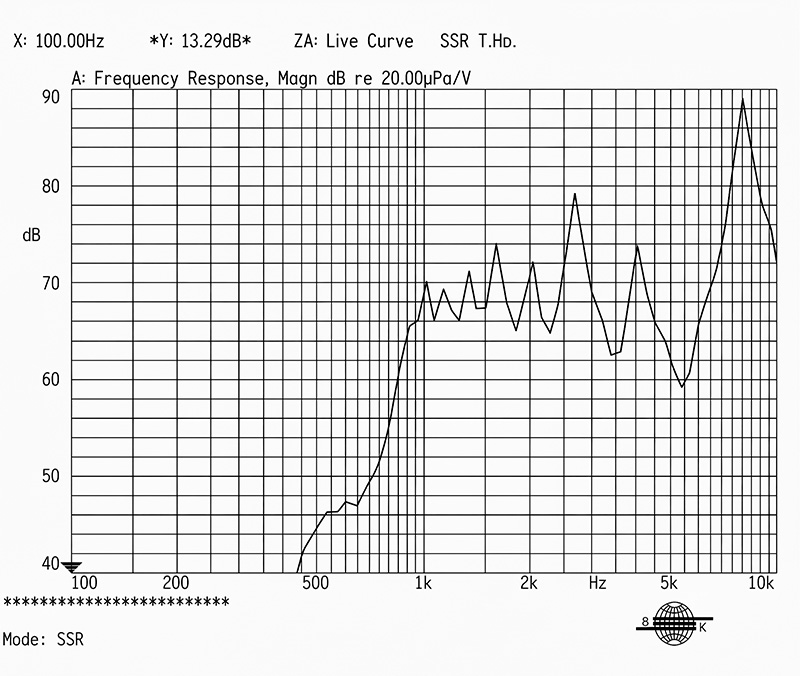
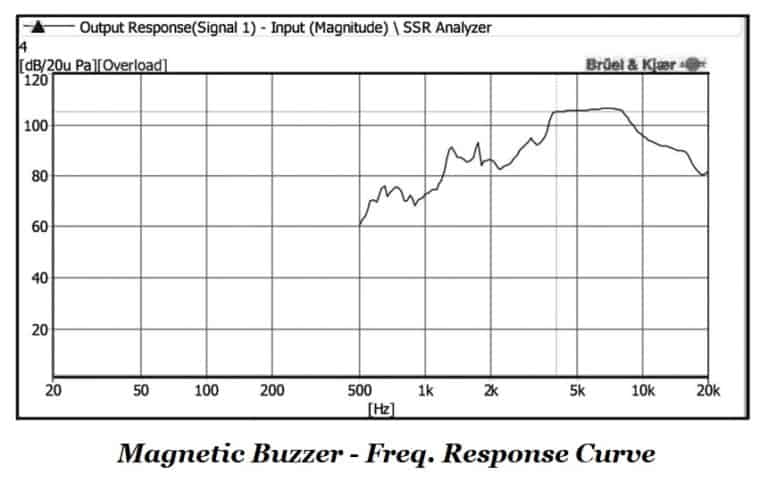
When analyzing a Frequency vs. SPL graph (typically measured at a distance of 10cm), the differences between the two components become visibly stark.
Piezo Buzzers
Produce a very high Sound Pressure Level (85dB to 120dB). On a frequency response graph, a piezo buzzer will display sharp peaks of extreme amplitude. Because of their ear-piercing SPL and high frequency, they are the undisputed standard for safety alarms and smoke detectors.
Magnetic Buzzers
Produce a lower, more moderate SPL (70dB to 95dB). However, they provide a much smoother curve on a frequency response graph, delivering a wider and more dynamic range of frequencies. This makes them highly desirable for consumer electronics requiring pleasant, less aggressive user-interface tones.
Source Custom Audio Solutions with ISL Products
To summarize, piezo buzzers offer larger frequency and SPL values, wide operating voltages, and minimal current draw. Conversely, magnetic buzzers offer smoother frequency responses, ultra-low operating voltages, and lower resonant frequencies at the cost of higher current consumption.
Each application is unique, and standard “off-the-shelf” parts rarely fit perfect engineering specifications. At ISL Products, we manufacture and supply custom buzzers tailored specifically to meet your exact required parameters.
