
Find ISL Products Online at 


Design Note
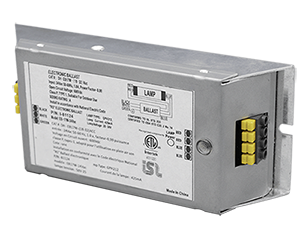
Ballasts for UV-C Lamps – The Basics
Regulate current and voltage for germicidal applications with high-efficiency electronic ballasts designed to maximize UV-C lamp life
Understanding Electronic Ballasts for UV-C Germicidal Lamps
As global awareness regarding sanitation and environmental safety reaches all-time highs, the integration of ultraviolet (UV-C) technology has become a necessity across commercial, medical, and residential sectors. Germicidal UV-C lamps are highly effective at neutralizing harmful pathogens, bacteria, and viruses. However, these specialized gas discharge lamps cannot operate independently. To function safely and efficiently, they require a critical external component: the electronic ballast.
For over 15 years, ISL Products has specialized in designing and manufacturing high-performance electronic ballasts specifically tailored for Mercury and Amalgam-based ultraviolet lamps. Understanding the fundamental electrical relationship between the ballast and the bulb is essential for engineers designing modern germicidal, purification, and sterilization systems.
What is an Electronic Ballast?
In simple terms, a ballast is an electronic device utilized to strictly regulate the current and voltage within an electrical circuit.
Historically, older gas discharge systems relied on bulky magnetic ballasts that operated via heavy steel core induction. Today, modern engineering dictates the use of electronic ballasts. By utilizing solid-state electronic circuitry instead of magnetic induction, electronic ballasts are vastly more compact, significantly lighter, and produce virtually zero acoustic noise. More importantly, they operate at much higher frequencies, which dramatically reduces lamp pulsing and results in the longest possible operational lifespan for the UV-C bulb.
How Ballasts Function with UV-C Lamps
The relationship between a UV-C lamp and its ballast is highly dynamic. The electrical requirements of the lamp change drastically from the moment it is turned on to the moment it reaches its steady operating state.
Overcoming Negative Resistance and Ignition
Mercury and Amalgam UV-C lamps possess a unique electrical characteristic known as negative resistance. This means that as the electrical current flowing through the gas increases, the voltage drops. If a lamp were connected directly to a raw power source without a ballast, the current would rapidly and exponentially increase until the bulb literally exploded or blew out.
To safely turn on (or “spark”) the lamp, a massive voltage difference is required between the two internal electrodes. The ballast takes the standard input voltage and rapidly ramps it up, converting it to the 400V to 1,000V required to successfully ignite the gas and achieve an electrical arc.
Current Regulation and Frequency Modulation
Once the lamp sparks and the arc is successfully achieved, the ballast instantly shifts its function. It drops the supplied voltage to a lower, safer working voltage (typically around 30 – 60V 300V, depending on the specific assembly) while strictly limiting the overall current draw.
Simultaneously, the internal printed circuit board (PCB) components—including a precise network of resistors, capacitors, and inductors—convert the standard sinusoidal AC input (usually 50-60 Hz) into a highly modulated 20 kHz to 80 kHz square or sine wave pulse output. This high-frequency modulation entirely eliminates the visible flicker originally associated with older gas-filled lamps, ensuring a continuous, highly effective stream of germicidal UV-C light.
High-Value UVC Applications
Because of their highly adaptable nature, custom electronic ballasts are used to power UV-C lamps across a wide spectrum of critical industries:
- HVAC and Air Purification: UV-C technology is heavily integrated into modern HVAC ductwork to continuously purify circulating air and prevent the buildup of mold and bacteria on cooling coils. Specialized 24VAC ballasts are frequently utilized to match standard HVAC control system voltages.
- Surface Disinfection: In high-traffic commercial settings, hospitals, and public transportation, UV-C light is deployed to rapidly sterilize surfaces and medical equipment without the use of harsh chemical liquids.
- Ozone Generation: Certain UV-C wavelengths actively produce ozone. When utilized in water treatment facilities or specialized air purification systems, the ozone and UV-C light work in tandem to aggressively destroy heavy pathogens.
- Industrial Manufacturing: UV-C ballasts are also implemented in heavy industrial applications, including pipe leak detection devices and rapid UV-curing systems for commercial printing and specialized adhesives.
Optimizing Your UV-C Ballast Solution
Because every application features unique physical constraints and power availabilities, off-the-shelf ballasts rarely provide an optimal solution. Electronic ballasts must be precisely tailored to match the exact specifications of the chosen Mercury or Amalgam germicidal bulb.
- Input Voltages: Ballasts can be engineered for a wide variety of power supplies. DC ballasts are typically designed for 12VDC or 24VDC systems, while AC ballasts can be configured for 110VAC to 220VAC.
- Global Compatibility: For products intended for international distribution, auto-switching ballasts are highly recommended to seamlessly adapt to varying global grid voltages.
- Multi-Lamp Configurations: For large-scale sanitation assemblies, a single, highly efficient ballast can be engineered to simultaneously drive and regulate multiple UV-C lamps, saving valuable chassis space and reducing overall component costs.
Source Custom Electronic Ballasts with ISL Products
Designing a UV-C disinfection system that provides consistent light output, high reliability, and exceptional safety requires an expertly engineered ballast. Every unique ISL Products ballast design is built to meet rigorous industry safety requirements and undergoes strict quality control testing before leaving our factory.
