
Find ISL Products Online at 


Design Note
Electromagnetic Interference (EMI) and the Effect on Electromechanical Devices
Identify and control electrical disturbances to ensure EMC compliance in complex electromechanical systems
Mitigating Electrical Disturbances to Ensure EMC Compliance
In the highly connected world of modern electronics, managing invisible forces is just as critical as managing physical footprints. Electromagnetic Interference (EMI) is a disruptive electrical disturbance within an electronic device caused by an external or internal energy source.
EMI can be generated by a massive array of everyday sources, including radio frequency (RF) transmitters, power lines, cell phones, microwaves, fluorescent lights, and especially electric motors. When designing a new electromechanical system, engineers must carefully consider the surrounding environment and the other electronic components within the device to determine its true susceptibility to EMI.
Understanding the Types of Electromagnetic Interference
Interference generally falls into two distinct categories based on how the disruptive energy travels from the source to the affected device: conducted and radiated.
Conducted Interference
An electrical device is highly susceptible to conducted emissions traveling through its own physical electrical path. This type of interference typically originates from lower-frequency noise generated by other electronics sharing the same power supply, system, or grid. The noise physically propagates along power cables and wire connections, negatively affecting other active devices connected to that shared source.
Conducted susceptibility refers to a device’s ability to operate effectively despite being impacted by this unwanted energy transmitting through its physical connections.
Radiated Interference
Unlike conducted emissions, radiated interference (often abbreviated as RFI, or Radio-Frequency Interference) requires absolutely no physical contact. This RF noise is broadcasted through the air as radio waves. It can be generated by high-powered external transmitters or even neighboring components within the same enclosed system.
Because these higher frequencies travel through the air, tracking down the exact source of radiated interference can be an arduous engineering challenge. To mitigate widespread disruption, the Federal Communications Commission (FCC) strictly regulates the electromagnetic spectrum, dictating specific operational bands to prevent harmful interference between commercial, medical, and consumer devices.
How DC Motors Generate EMI
DC motors—particularly traditional brushed varieties—inherently generate a massive amount of electrical noise. The fundamental operation of a motor involves the constant switching of electromagnetic fields. This creates rapid, aggressive changes in voltage and current that can easily induce unwanted frequencies onto neighboring conductors.
Furthermore, the physical arcing caused by the mechanical carbon brushes rubbing against the commutator acts as a highly potent source of radiated emissions. It is also crucial to note that the supplementary systems built around a DC motor, such as relay arrays or Pulse Width Modulation (PWM) drivers, generate their own heavy emissions.
While high-quality motors are designed to minimize noise, Electromagnetic Compatibility (EMC) compliance is ultimately determined by the Original Equipment Manufacturer’s (OEM) finished, enclosed product, not the individual component supplier.
Interference Testing: Achieving Electromagnetic Compatibility (EMC)
To ensure a product functions safely in the real world, it must undergo rigorous EMC testing at a certified laboratory. The specific industry and destination country dictate the exact standard a product must meet (e.g., IEC standards for medical devices, or MIL standards for military equipment).
- Conducted and Radiated Emissions Testing: The lab analyzes the device to measure exactly what frequencies it is transmitting—either through its cables (conducted) or through the air (radiated).
- Conducted and Radiated Susceptibility Testing: The lab bombards the device with targeted frequencies to determine its physical immunity. They define how much interference the device can absorb before its operation is negatively impacted or severely compromised.
Proven EMI Mitigation Strategies
Finding the potential sources of EMI within a dense electrical system is difficult, but effectively neutralizing them is entirely possible through various mitigation techniques:
- Cable Shielding and Grounding: A highly effective method for reducing conducted EMI. Wrapping cables in a grounded, conductive shield traps the noise.
- Ferrite Beads and Chokes: Clamping a ferrite choke onto power cords and data cables helps suppress and dissipate excess high-frequency noise before it reaches the sensitive circuitry.
- Faraday Cages: To combat radiated emissions, engineers can enclose the sensitive device (or the offending noise source) inside a highly conductive material. This physical shielding provides signal attenuation by reflecting and absorbing electromagnetic waves.
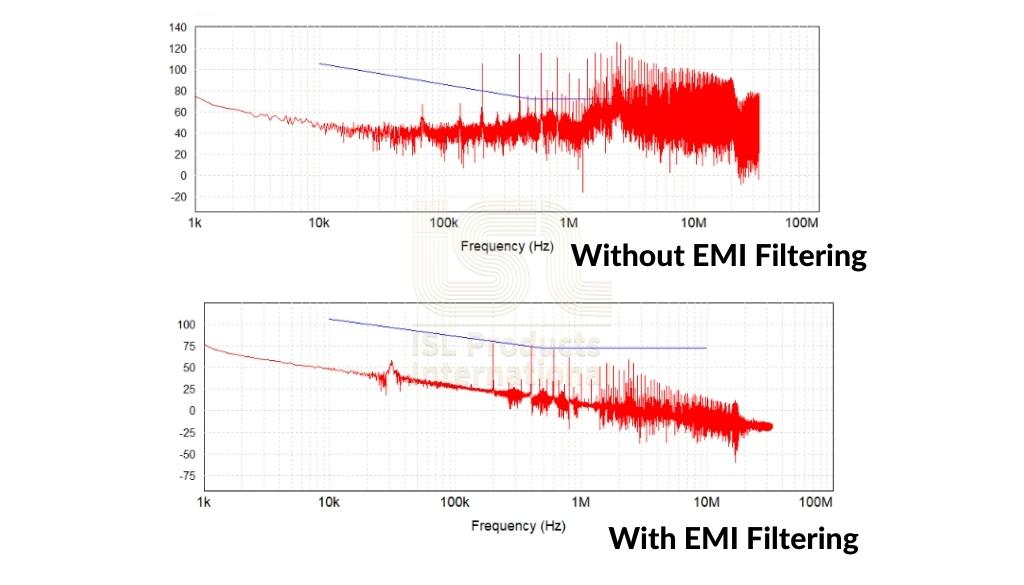
Decoupling Capacitors: For DC motors, the most common and cost-effective mitigation method is soldering a decoupling capacitor directly between the motor’s terminals. This effectively filters out high-frequency voltage spikes and transient noise caused by the brush arcing.
